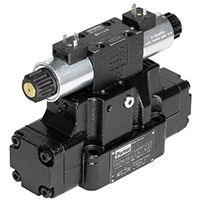
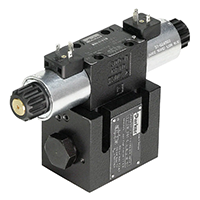
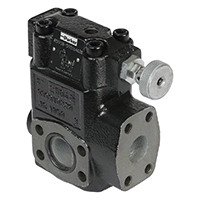
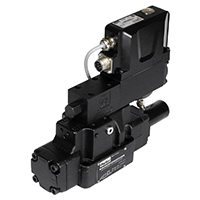
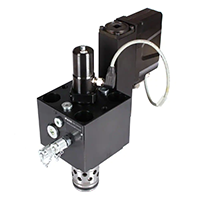
Hydraulic Valves
Get advice and suggestions from DTA in order to select the appropriate hydraulic valve, in terms of size and function, that suits your application and your budget. Contact DTA today!
A hydraulic valve properly directs the flow of a liquid medium, usually oil, through your hydraulic system. The direction of the oil flow is determined by the position of a spool. A hydraulic system can only function - as per requirements - by using valves. Thus, you should always look for the correct type of hydraulic valve to serve your intended purpose.
Hydraulic valves are available in a variety of sizes. The size required is determined by the maximum flow of the hydraulic system through the valve and the maximum pressure in the hydraulic system. Hydraulic valves are available with different mountings: e.g. mounting in pipe lines, threaded connection as cartridges, subplate mounting, etc.
Hydraulic valves are available from several major vendors; our preferred hydraulic valve suppliers are Parker Hannifin and Denison Hydraulics. Additionally, we supply hydraulic valve parts and accessories such as sub plates, seal kits, O-rings, solenoids and hydraulic valve control electronics.

Directional control valves Pressure control valves
Note that proportional hydraulic valves and servo control valves may be used to perform a directional control, pressure control or flow control function.
Back to hydraulics overview - Hydraulic Parts
What is a Hydraulic Valve and Why Do You Need It?
Hydraulic valves are available in a variety of sizes. The size required is determined by the maximum flow of the hydraulic system through the valve and the maximum pressure in the hydraulic system. Hydraulic valves are available with different mountings: e.g. mounting in pipe lines, threaded connection as cartridges, subplate mounting, etc.
How DTA Can Help You:
DTA has extensive expertise with hydraulic valves and carries a substantial inventory of valves in different sizes and spool configurations. Depending on your requirements, DTA can supply high-quality hydraulic valves, taking into account a wide variety of functional and hydraulic system requirements.Hydraulic valves are available from several major vendors; our preferred hydraulic valve suppliers are Parker Hannifin and Denison Hydraulics. Additionally, we supply hydraulic valve parts and accessories such as sub plates, seal kits, O-rings, solenoids and hydraulic valve control electronics.
Different Types of Hydraulic Valves
Hydraulic valves are sometimes referred to as hydraulic components. These are subdivided into three main categories: directional control valves, pressure control valves and flow control valves. We have added proportional and servo control hydraulic valves as a separate category below:
Directional control valves Pressure control valves
- Control task: variable throttle valves
- Switching task: fixed throttle valves

- Servo hydraulic valves
- Proportional hydraulic valves
Note that proportional hydraulic valves and servo control valves may be used to perform a directional control, pressure control or flow control function.
Back to hydraulics overview - Hydraulic Parts
Directional Control Valves
The performance of a directional control valve depends on the following:
- Dynamic power limit (as a function of maximum flow and pressure)
- Static power limit (adhesive force may be produced between the spool and housing due to standstill)
- Resistance to flow (internal resistance, i.e. pressure drop)
- Leakage (spool valves only)
- Switching time (time between the actuating force and the completion of the stroke of the control element)
Back to top - Hydraulic Valves
Check Valves
A check valve is the simplest type of directional control valve used in hydraulic systems. Check valves stop the flow of fluid in one direction and allow free flow in the opposite direction. They are also known as non-return valves. Check valves may be used as:
- Prefill valves (anti-cavitation)
- Bypass valves (e.g. throttling points or return-line filters)
- Stops for flow in one direction
- Pre-tensioning by creating a certain backpressure
- Protection of hydraulic components against pressure surges
There is a special type of check valve that prevents pistons or cylinder plungers from coming down and causing accidents. This is called a line rupture valve. When the line ruptures, the flow through the line rupture valve increases substantially, causing an increased pressure drop. This in turn creates a stronger force on the ball, which will close immediately.
Other special types of check valves are pilot-operated check valves and shuttle valves. A pilot-operated check valve allows flow in either direction by application of an external pilot pressure signal. A shuttle valve permits free flow at the highest operating pressure.
Back to top - Directional Control Valves
Directional Spool Valves
Directional spool valves comprise a moving spool situated in the valve housing. When an actuating force moves the control spool, the annular channels in the housing are connected or separated. Directional spool valves have several unique features, such as:
- Low cost due to simple design
- Low actuating force (due to good pressure compensation)
- High switching power
- Low losses (even though oil leakage flows continuously from the high pressure to the low pressure side)
- Wide variety of control functions
When valves are operated at higher hydraulic system operating pressures, leakage losses around the spool and the housing should be taken into account, especially at system pressures over 350 bar. The leakage loss is determined by the size of the gap between the spool and the housing, the viscosity of the hydraulic fluid and the hydraulic system pressure.

Typical parameters of spool valves are:
- Nominal sizes: NG6 and NG10 (up to NG120 for pilot-operated valves)
- Maximum flow: up to 150 l/min (up to 7,000 l/min for pilot-operated valves)
- Maximum pressure: up to 350 bar
Directional Poppet Valves
Directional poppet valves can operate at a maximum operating pressure of up to 1,000 bar. Directional poppet valves are directional control valves that are fitted into housing bores with a threaded connection. This is why they are often referred to as hydraulic cartridge valves. The moveable seating elements may consist of balls, poppets or plates.
Key features of hydraulic cartridge valves:
- No leakage
- Long product life
- High maximum and continuous operating pressures due to zero leakage losses
- Very good sealing characteristics without additional isolating elements

Typical parameters of poppet valves are:
- Nominal size: NG6 and NG10, SAE, and ¼" - 2" BSP
- Maximum flow: up to 60 l/min (up to 400 l/min for pilot-operated valves)
- Maximum pressure: up to 1,000 bar
Pressure Control Valves

Control task (variable throttle)
- Pressure relief valves
- Pressure reducing valves
- Pressure drop valves
- Pressure difference valves
- Pressure valves with additional electric switch-off
- Pressure shut-off valves
- Pressure sequence valves
The most common types of pressure control valves are the pressure relief valve and the pressure reducing valve. Pressure relief valves control the system pressure by relieving part, or all, of the flow to tank. Pressure reducing valves reduce the pressure supplied to a sub-system of a hydraulic system.
Pressure control valves may be directly or pilot operated. Larger flows require larger spools or poppets, which increases the area of the spring diameter: the spring force increases proportionally. Pilot-operated pressure control valves require only a small spring, are suitable for compact space requirements and have maximum flows of up to 650 l/min.
Back to top - Hydraulic Valves

Pressure Relief Valves
There are two pressure control valves: one is a pressure relief valve, and the other is a pressure reducing valve. Pressure relief valves have higher flow capacities than pressure reducing valves because pressure relief valves have to be capable of directing all flow to the tank.Pressure relief valves are used in hydraulic systems to limit the system pressure to a specific set level. If this set level is reached, the pressure relief valve responds and feeds the excess flow from the system back to the tank.
Note: the pressure relief valve is a normally closed pressure control valve.
Back to top - Pressure Control Valves

Pressure Reducing Valves
In contrast to pressure relief valves, which affect the level of input pressure (i.e. pump pressure) fed into the hydraulic system, pressure reducing valves are used to influence the output pressure of the hydraulic system to a subsystem (e.g. actuator pressure).Reducing the input pressure (primary pressure) or maintaining a particular output pressure (secondary pressure) is achieved at a set value which is below the varying pressure occurring in the main hydraulic circuit. It is thus possible to reduce the pressure in one part of the circuit to a lower level than the system pressure.
Note: the pressure control valve is normally open.
Back to top - Pressure Control Valves
Flow Control Valves
These are called throttle valves and they are regularly used in combination with a check valve, i.e. the throttle check valve for speed control in one direction of flow. A disadvantage of throttle valves is that at varying loads a change in pressure drop will change the flow; thus, the speed of the moving actuator will also be affected. Flow control valves are divided into two types:

Throttle valves (flow depends on Δp)
- Viscosity dependent
- Viscosity independent
- 2-way flow control valves
- 3-way flow control valves
Flow control valves are used to influence the speed of movement of actuators by changing the opening for the flow (decreasing or increasing it) at the throttling point. In fact, these are two flow control valves placed in series and built together. The throttling point operates at a fixed setting, but the throttle opening before the throttling point varies with pilot pressure of the load.
Note that flow dividers have a certain special standing: they divide an oncoming flow into two or more flows. Usually it is used to distribute the flow of a single pump to two or more sub-systems that have different operating pressures.
Back to top - Hydraulic Valves
Throttle Valves
Throttle valves come in piston and needle-valve structures, but we also know them as turn plugs with axial or radial grooves. The smothering of grooves is more accurate but provides more variability than those with piston structures. The needle throttle has one disadvantage: a great deal of power is required to move the needle only a slight amount.The pressure difference (Δp) determines the amount of flow that passes the throttle. In systems with varying loads (and therefore varying pressures), the flow passing the throttle will always be different.
You can find non-adjustable (fixed) smothering in situations where it is needed to gauge against excessive pressure surges. Also, one can find non-adjustable throttles in control systems.
Back to top - Flow Control Valves
Flow Control Valves
A pressure-compensated flow control valve has a fixed throttling flow at all pressures. The two-way pressure-compensated flow control valve is also called a series valve. The pressure reducing valve and the smothering of this valve are placed in series with each other. At a three-way pressure control valve, the pressure relief valve and the throttle in this valve are parallel to each other.The two-way and three-way pressure compensated flow control valves are quite similar. The only difference is that in the latter type, the excess oil flow is not drained through the pumps safety valve but through the flow control valve itself. The pump pressure for a three-way pressure compensated flow control valve is always equal to the pressure exerted by the actuator plus the spring pressure.
Note that using three-way flow control valves increases efficiency because the system pressure will never be higher than as required for moving the load. With two-way flow control valves, this is not the case because the pump keeps feeding the system with oil until the preset pressure of the pump's safety - pressure relief - valve has been reached.
Back to top - Flow Control Valves
Electro-hydraulic Valves
Proportional hydraulic valves are able to control the opening to flow proportionally instead of gradually, as is the case for most standard hydraulic valves. The simplest type of proportional hydraulic valve is a variable throttle controlled by a manual lever, as illustrated below:
Proportional and servo hydraulic valves are usually classified as high-performance valves. This distinction gives an expected indication of performance, which tends to generalise the true differences between various types of servo and proportional hydraulic valves. Each type has its own unique performance characteristics either in controlling pressure or controlling flow.
Servo hydraulic valves use closed-loop control to monitor and feed back the main-stage spool position to a pilot stage (hydraulic/pneumatic) or driver (electronic). Proportional hydraulic valves, on the other hand, move the main-stage spool in direct proportion to an external piloted control signal and do not have any means of feedback within the valve.
Back to top - Hydraulic Valves
Servo Valves
The main stage spool of a servo hydraulic valve is equipped with a path measuring system for accurate adjustment. This system measures the exact position of the main-stage spool and feeds its position directly to the electronic control unit. If sworn position is not consistent, the control signal corrects the position of the main-stage spool.Servo hydraulic valves are widely used in aerospace and industrial applications.
Back to top - Electro-hydraulic Valves
Proportional Valves
The most common proportional hydraulic valves are directional control valves, pressure relief valves, flow controllers and adjustable throttling. Proportional hydraulic valves convert an incoming mechanical or electrical signal directly proportional to a shear mode. The movement follows a continuously incoming signal. Different types of available proportional hydraulic valves are:- Various directional control valves
- Flow control valves
- Pressure relief valves
- Pressure reducing valves
- Counter balance valves
Back to top - Electro-hydraulic Valves
Projects
New Corporate Identity DTA
In 2009, DTA decided to completely redesign its corporate identity. By the end of 2009, the new look came into effect. We started our trajectory of web development at the same time.
Read more about this project
See all projects
Parker Hydraulics

Hydraulic Valves
DTA supplies pressure, flow and directional control valves in spool and cartridge design.
Hydraulic Valves
Hydraulic Cylinders
Standard cylinders in mill type or tie rod design. Engineering and servo cylinders.
Hydraulic Cylinders
Hydraulic Motors
Contact DTA today for all your hydraulic motor needs, spare motor parts and repairs.
Hydraulic Motors
Hydraulic Filters
Protect your high-grade hydraulic parts with high-quality hydraulic filters from DTA!
Hydraulic Filters